RECOGNITION OF FOREIGN QUALIFICATIONS
If you have obtained a diploma or other educational document abroad and plan to continue your studies or work in Ukraine, your document must undergo a formal recognition procedure. This allows you to establish the compliance of your qualifications and level of education with the state standards of Ukraine and guarantees the legal validity of the document on the territory of our country.
The procedure is carried out in accordance with:
- The Lisbon Convention on the Recognition of Qualifications in Higher Education in the European Region (ratified by the Law of Ukraine dated 03.12.1999 No. 1273-XIV) and the recommendations of this Convention;
- the current legislation of Ukraine in the field of education;
- the internal regulations of the International European University.
After completing the procedure, you will receive a Certificate of Recognition of a Foreign Educational Document. It confirms your right to:
- continue your studies at higher education institutions in Ukraine;
- to be officially employed in the relevant speciality.
The presumption of recognition applies in all cases: qualifications are recognized unless the University has demonstrated the existence of substantial differences between the acquired competencies and the corresponding learning outcomes of the educational programme. The university recognizes study times from other institutions unless it can provide evidence of substantial differences between the competencies to be recognized and the parts of the study programme that they are supposed to replace.
Refusal of recognition is possible only if substantial differences are documented. Such a decision must be transparent, well-reasoned, and communicated to the applicant in writing.
Necessity of evaluation. Consideration and academic recognition of foreign education documents are mandatory conditions for participation in the competitive admission process to the International European University.
Priority of fairness. Every holder of a foreign qualification has the right to recognition of their learning outcomes, unless substantial discrepancies in the content or outcomes of the educational programmes are proven. An official written justification must accompany any refusal of recognition.
Connection with future studies. During the evaluation, account is taken of the specific programme and educational level to which the applicant intends to apply, as well as whether a complete package of documents defined by the admission rules has been submitted.
Equivalence of levels. A foreign education document may be recognized as equivalent to a Ukrainian document for complete general secondary education or higher education of the relevant level, provided there are no substantial differences in educational standards.
Individual consideration. Each qualification is analyzed individually, using international information resources, recommendations from ENIC/NARIC centers, and the precedent of previous decisions, which ensures consistency and transparency in the procedure.
Conditional admission. Even if a foreign qualification is recognized as equivalent to a Ukrainian one, this does not guarantee automatic enrolment. Admission takes place in accordance with the general rules and competitive requirements of the University.
- Verification of document authenticity - confirmation that the diploma or certificate was issued legally and is valid. If the document has an "Apostille" stamp or consular legalisation, this significantly speeds up the procedure.
- Verification of the status of the educational institution - this stage includes verification of the existence of a certificate of state accreditation of the educational institution and a licence at the time of issuing your educational document.
- Establishing the equivalence of the qualification specified in a foreign educational document to the requirements for educational or educational-qualification levels of the Ukrainian education system (carried out with the involvement of expert commissions in the relevant specialities) or the period of study.
Comparative analysis of educational programmes is a comparison of educational programmes in terms of content and scope, carried out by an educational institution in Ukraine accredited in the same speciality as that indicated in the applicant's diploma. If such a speciality does not exist in Ukraine, the closest existing one is selected.
For countries with which Ukraine has concluded international agreements establishing the equivalence of educational documents and academic degrees, the educational and qualification level is determined by the Ministry of Education and Science of Ukraine on the basis of the relevant international agreements. Such international agreements simplify the recognition procedure, but do not cancel it.
Documents on education issued in countries with which Ukraine has concluded relevant intergovernmental agreements do not require recognition, namely:
- documents issued in the Republic of Azerbaijan before 1 January 1992, on the basis of Article 3 of the Agreement between the Ministry of Education of Ukraine and the Ministry of Education of the Republic of Azerbaijan on cooperation in the field of education dated 24 March 1997 ;
- documents issued in the Republic of Kazakhstan before 1 January 1992, on the basis of Article 3 of the Agreement between the Ministry of Education of Ukraine and the Ministry of Education of the Republic of Kazakhstan on cooperation in the field of education dated 21 September 1995 ;
- documents issued in the Republic of Tajikistan before 1 January 1992, on the basis of Article 3 of the Agreement between the Ministry of Education and Science of Ukraine and the Ministry of Education of the Republic of Tajikistan on cooperation in the field of education dated 9 April 2003 ;
- documents issued in Turkmenistan before 1 January 1993, based on Article 3 of the Agreement between the Ministry of Education of Ukraine and the Ministry of Education of Turkmenistan on cooperation in the field of education dated 28 January 1998 .
If necessary, you can contact the National Information Centre for Academic Mobility – ENIC Ukraine to obtain a certificate or confirmation of your educational document.
If additional verification or determination of the level of education in the Ukrainian system is required, the recognition procedure can be completed in person or through an authorised representative.
The recognition procedure is not applied to:
- documents issued by educational institutions that are not officially registered (accredited) as entities authorized to provide educational services in their respective countries;
- documents issued by branches of educational institutions, if these branches are not officially registered (accredited) as entities authorized to provide educational services in the countries within which they conduct educational activities;
- documents that do not contain any information about the acquisition by their holder of a specific educational or qualification level that entitles the holder to academic or professional rights;
- non-authentical documents;
- documents failing to meet the respective state standard and issued in a country the international agreements with which provide for the recognition of exclusively state standard documents;
- educational documents testifying finishing a program that cannot be correlated with any educational or qualification level and (or) field of study (specialty, qualification) of the educational system of Ukraine;
- educational documents that are not recognized by the state of origin;
- educational documents that do not contain sufficient information on the content of the curriculum that makes impossible to assess the qualification and learning outcomes and establish equivalence to the education system of Ukraine;
- educational documents issued before 15.05.1992 by educational institutions of the former USSR.
- educational documents that have the number of the ECTS credits earned less than 30 (or equivalent amount of hours).
Ukraine has withdrawn from the Agreement on Cooperation in the Field of Education, conducted in Tashkent on May 15, 1992. On March 23, 2023 the Agreement was terminated for Ukraine.
The International European University operates in accordance with the Lisbon Convention on the Recognition of Qualifications in Higher Education in the European Region and the current regulations of Ukraine.
One of the key principles of the Convention is to ensure the right of refugees and persons of equivalent status to have their qualifications recognised, even if they are unable to provide a complete set of documents.
The procedure of recognition of qualifications held by the refugee applicants or persons in need of complementary protection differs from the standard procedure of recognition, and is subject to international rules according to the Convention relating to the Status of Refugees, 1951, and the Protocol relating to the Status of Refugees, 1967.
The procedures for the recognition of foreign educational documents were introduced by Order of the Ministry of Education and Science of Ukraine No. 504 of 5 May 2015, registered with the Ministry of Justice of Ukraine on 27 May 2015 under No. 614/27059 (as amended by Order of the Ministry of Education and Science No. 784 of 5 September 2022, registered with the Ministry of Justice of Ukraine on 21 October 2022 under No. 1288/38624), establishes the principles for all competent authorities to follow in the procedure for recognising the qualifications of refugees and persons in need of additional or temporary protection.
Refugees and persons in need of additional or temporary protection have the right to have their qualifications recognised by the competent recognition authority without having to provide a full set of documents.
Despite the absence of all necessary documents the persons with the refugee status are entitled to have their credentials assessed by the competent recognition authorities. The recognition procedure of credentials of such applicants may be initiated without the complete package of documents unlike the ordinary rules of recognition procedure, and presupposes the simplified process.
The basis for initiating the procedure is the availability of one of the following documents:
- refugee certificate;
- certificate of a person in need of subsidiary protection;
- temporary protection certificate;
- certificate of application for protection in Ukraine.
In order to undergo the recognition procedure, refugees and persons in need of additional or temporary protection shall provide their available educational documents, such as:
- copies of diplomas, certificates or academic transcripts;
- student ID card, transcript, course description;
- documents on non-formal or informal education;
- documents on work experience (employment record book, contract, certificates, etc.).
If the information is insufficient, the procedure may include:
- specially organised examinations;
- testing;
The results of these measures are taken into account when deciding on recognition.
Who processes the documents?
Documents for the decision on the recognition of foreign education documents are processed by
State Enterprise "Information and Image Centre" of the Ministry of Education and Science of Ukraine,
which performs the functions of the National Information Centre for Academic Mobility – ENIC Ukraine (in accordance with the Resolution of the Cabinet of Ministers of Ukraine No. 924 of 31 August 2011).
Competent authorities and their decisions
1. Ministry of Education and Science of Ukraine
- Purpose: enrolment of the document holder in educational institutions of Ukraine and/or pursuit of professional activities.
- Result: a Certificate of Recognition is issued, confirming your right to study or work in your profession in Ukraine.
📍 Documents can be submitted:
- In person – Kyiv, 25 Vyacheslav Chornovil Street, State Enterprise "Information and Image Centre" (according to the schedule).
- Online – via the official website of ENIC Ukraine.
📞 Contacts:
+380 (44) 486-20-43
+380 (44) 486-25-43
✉️
2. Higher education institutions in Ukraine
- Purpose: enrolment of the document holder for study at this particular institution.
- Result: a Certificate of Recognition is issued, which is valid within the specific university.
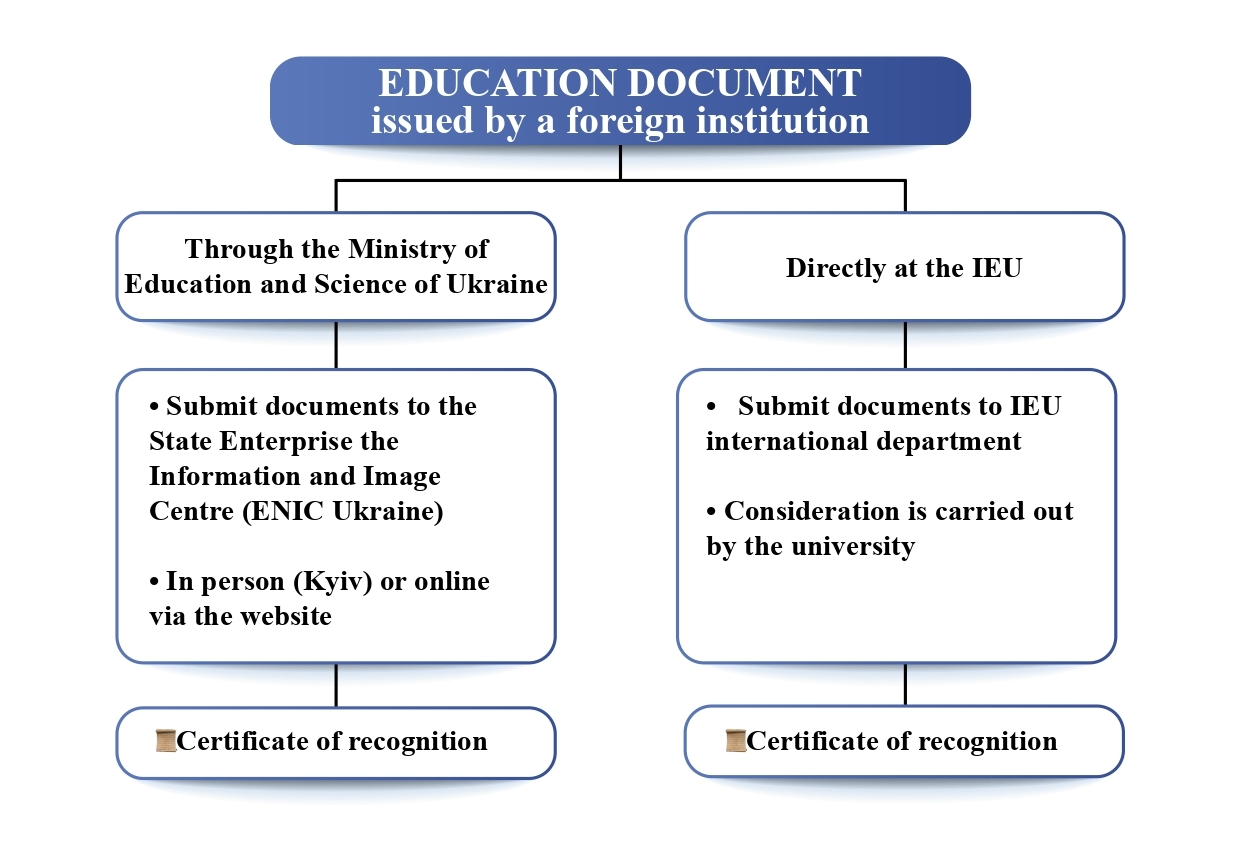
The IEU has established a Commission for the Recognition of Educational Documents issued by educational institutions in other countries.
It operates on the basis of official regulations and is responsible for:
- reviewing submitted documents;
- verifying their compliance with the requirements of Ukrainian legislation;
- making decisions on recognition and issuing certificates.
This means that you can go through the recognition procedure directly at our university - quickly and taking into account the specifics of your chosen educational programme.
Order on the Establishment of the Commission for the Recognition of Foreign Educational Documents
For more information, please call +380 (50) 713-36-24, +380 (44) 338-00-43, or email:
The recognition procedure at the International European University is carried out in accordance with
Documents to be submitted to the Commission for the recognition procedure:
To undergo the recognition procedure at the International European University, the following documents must be submitted:
- Application
- Copy of the Document with a notarised translation into Ukrainian
- Copy of the appendix to the document and/or other documents containing information about the content of the study programme with a translation into Ukrainian.
*Documents must be legalised in the country of origin.
*For countries that are parties to the Hague Convention (1961), an Apostille stamp is sufficient.
*For countries with bilateral or multilateral agreements with Ukraine, an apostille is not required.
- Copies of documents on previous education (if available)
- Copy of the passport/ID card of the applicant and the document holder (if they are different persons)
- Copy of the document confirming the change of surname (if necessary)
- Application form for verification of personal data
- Consent form for the processing of personal data
- Document confirming payment for the service or confirmation of exemption from payment.
- Power of attorney – if the documents are submitted by a representative.
🔹 Additional materials confirming education, qualifications or professional experience (certificates, references from work, etc.) may also be provided.
- In person or through a representative – in paper form at the following address: 42V Akademician Hlushkov Avenue, Kyiv, room 424
Online – in the form of scans/digital copies (the Commission has the right to verify their conformity with the originals) to email:
⚠️ If the set of documents is incomplete or incorrectly completed, the Commission will notify you of the deficiencies. In this case, you will have 10 working days to correct them.
1. Verification of document authenticity
- the presence of an Apostille stamp (for countries that are parties to the 1961 Hague Convention) and its registration are verified;
- the official register of educational documents is used (if it exists in the country of origin);
- if necessary, a request is sent to the competent authorities or the university that issued the document.
If there is an approved standard for the design of diplomas in the country, the submitted document is analysed for compliance with this standard.
2. Verification of the status of the educational institution
- use of national accreditation and licensing registers;
- verification through international official sources and databases;
- request to educational authorities or institutions abroad.
This ensures that the diploma was issued by an officially recognised educational institution.
3. Establishing equivalence of qualifications
- for countries with which Ukraine has international agreements, equivalence is determined on the basis of these agreements;
- For other countries, a comparative analysis of programmes is carried out: content, scope, number of credits, expected learning outcomes, study period.
⚠️ The existence of an international agreement does not exempt you from the need to go through the recognition procedure and obtain an official decision.
4. Comparative analysis of the curriculum
The following are assessed:
- the level of education and the place of the diploma in the national system of the country of origin;
- the scope and content of the programme (ECTS credits or academic hours);
- the quality and profile of the programme or institution;
- the professional and academic rights conferred by the document.
The Recognition Commission prepares a Conclusion. Based on the Commission's Conclusion, the Academic Council of the University shall adopt one of the following decisions, which shall be formalised in accordance with the procedure established by law:
✅ Possible decisions:
- Recognition – the applicant is issued a Certificate of Recognition. Recognition is granted if substantial differences are not identified.
- Recognition after fulfilling additional conditions – Conditional recognition is granted and the applicant must fulfill additional requirements (for example additional studies) in order to be accepted. The applicant may be offered:
- undergo additional training;
- take tests or exams to confirm their competencies.
After that, the procedure continues until successful completion.
- Refusal of recognition. Non-recognition decision is made if substantial differences in the quality of learning outcomes, program elements, programs, or higher education institutions are identified.
In case of refusal, the Applicant shall be sent a corresponding notification stating the reasons for such a decision.
⚠️ The grounds for refusal of recognition may be as follows:
- the document was issued by an institution that is not officially recognised in its country;
- the document was issued by a branch of an institution that does not have a licence/accreditation;
- there is no information about the degree or specialisation obtained;
- the document was issued unlawfully or is not authentic;
- the course lasted less than 1 academic year or contains less than 30 ECTS credits;
- the document does not comply with the official standard of design in the country of origin;
- the programme does not correspond to any Ukrainian speciality;
- the document is not recognised in the country that issued it;
- there is insufficient information about the content of the programme to establish equivalence;
- it has been found that the document was obtained on the basis of inauthentic prior education.
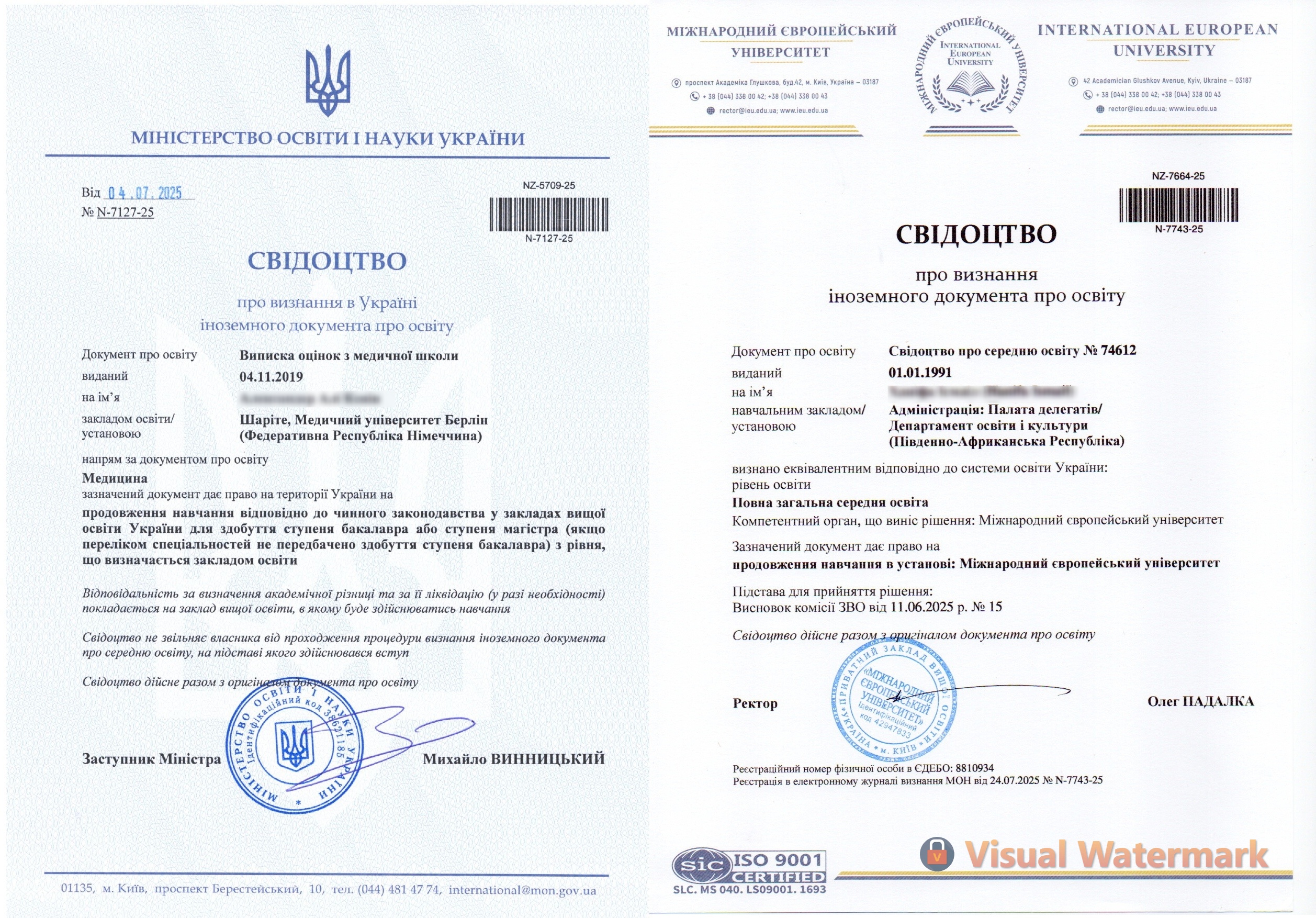
📜 Certificate of recognition
- Issued in Ukrainian (and in another language if necessary).
- Valid only together with the original document.
- It is valid indefinitely.
- The university may review the decision of the Ministry of Education and Science only in favour of a more favourable outcome for the holder.
- The period for issuing the Certificate to the Applicant may not exceed 45 calendar days from the date of receipt of all documents and information necessary for the recognition procedure.
📌 Sample Certificate
In accordance with the Lisbon Convention on the Recognition of Qualifications in Higher Education in the European Region (1997), every holder of foreign educational documents has the right to a transparent and understandable appeal procedure.
⏱ Deadline for filing an appeal
If you disagree with the outcome of the recognition procedure, you can lodge an appeal within 3 months of receiving the decision.
📑 Documents for appeal
For reconsideration, you must submit:
- an application for review of the decision;
- a consent form for the verification of personal data (to be completed by the document holder);
- a consent form for the processing of personal data (from the owner and/or applicant);
- a copy of the Certificate of Recognition or letter of refusal;
- a copy of the education document for which the decision is being appealed;
- additional documents that may affect the review (with translation, if necessary);
- a copy of the owner's passport (with translation, if necessary);
- a copy of the power of attorney and passport of the representative (if the documents are submitted by an authorised person).
🔎 How is the review conducted?
- The submitted documents are checked within 10 working days for completeness and correctness.
- The Commission then reassesses the qualification, taking into account the arguments and additional materials provided.
- The appeal review takes no more than 4 months from the date of receipt of the complete set of documents.
📜 Result
- If the decision is changed, a Certificate of Recognition is issued.
- If the change is denied, an official letter is sent stating the reasons.
- Constitution of Ukraine (Articles 24 and 26);
- Law of Ukraine "On the Legal Status of Foreigners and Stateless Persons" (1994);
- Law of Ukraine "On Education";
- Law of Ukraine "On Higher Education";
- Lisbon Convention of 1997 (Convention on the Recognition of Qualifications concerning Higher Education in the European Region);
- Recognition Procedure for Higher Education Degrees Issued by Foreign Educational Institutions (approved by Order No 504 of the Ministry of Education and Science of Ukraine, dated May 05, 2015);
- Recognition Procedure for Educational Documents on Secondary and Vocational Education Issued by Foreign Educational Institutions (approved by Order No 504 of the Ministry of Education and Science of Ukraine, dated May 05, 2015);
- Bilateral agreements on mutual recognition and equivalency of education-confirming documents and academic degrees;
- List of Qualifications Whose Holders Are Trained in Institutions of Higher Learning to the Specialist and Master Degree (approved by Cabinet of Ministers Resolution No 787, dated August 27, 2010, as amended and supplemented);
- List of Areas in Which Professionals Are Trained in Institutions of Higher Learning to the Bachelor Degree (approved by Cabinet of Ministers Resolution No 1719, dated December 13, 2006);
- List of Qualifications Whose Holders Are Trained in Institutions of Higher Learning to the Junior Specialist Degree (approved by Cabinet of Ministers Resolution No 839, dated August 20, 2007, as amended and supplemented);
- The Convention Abrogating the Requirement for Legalization of Foreign Public Documents (the Hague Convention), 1961;
- Decree No 94 of the President of Ukraine “On the Consular Statute of Ukraine,” dated April 2, 1994 (page 54);
- Order No 113 of the Ministry of Foreign Affairs of Ukraine "On Approving the Instruction on the Procedure for Consular Legalization of Public Documents in Ukraine and Abroad," dated June 4, 2002;
- Resolution No 924 of the Cabinet of Ministers of Ukraine “Issues Related to the National Information Centre of Academic Mobility,” dated August 31, 2011.

Address
Phone
Email 


